

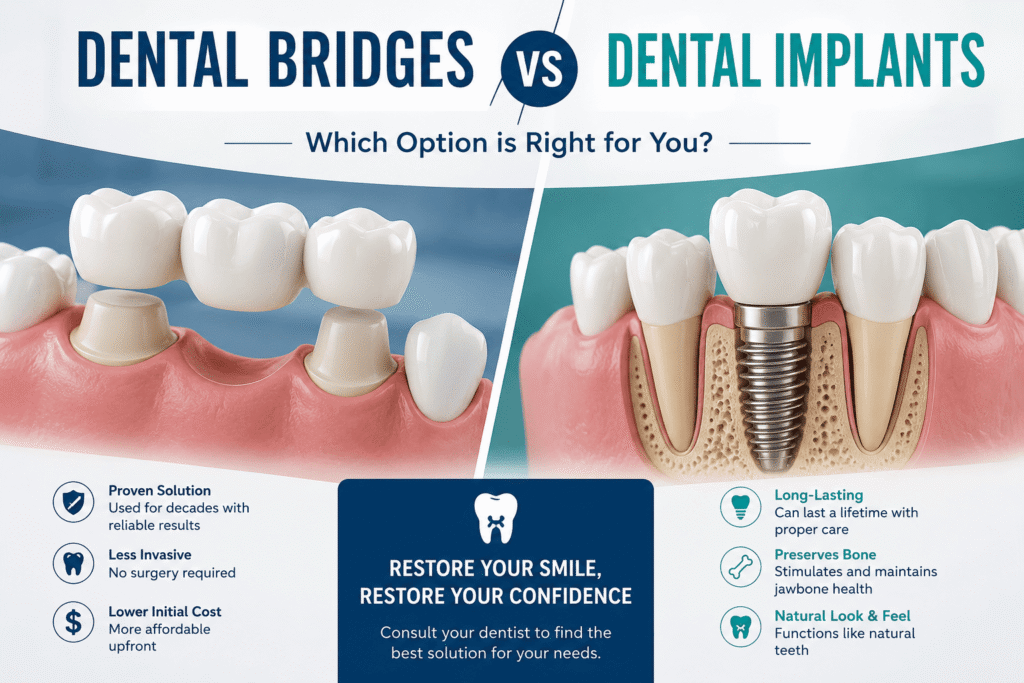
Two proven ways to replace a missing tooth and a clear, honest comparison to help you decide which one suits your mouth, your timeline and your budget.
When you lose a tooth, doing nothing is rarely the right answer. The teeth either side of the gap can drift and rotate into the space, your bite changes, and the risk of gum disease and jaw joint problems goes up. Replacing the tooth protects everything around it.
At St Peter’s Lodge in St Albans, the two treatments we discuss most often are the dental bridge and the dental implant. Both fill the gap with something fixed and permanent. They go about it in completely different ways, and neither is automatically the better choice.
A bridge borrows support from the teeth on either side of the gap. An implant creates its own support, from the jawbone up. That single difference drives almost everything else cost, treatment time, how much of your natural tooth is removed, and how long the result lasts.
Bridges vs implants at a glance
| Dental bridge | Dental implant | |
|---|---|---|
| How it is supported | Cemented onto the natural teeth either side of the gap (the abutment teeth) | A titanium screw placed into the jawbone acts as an artificial tooth root |
| Cost | Quoted at consultation | Quoted at consultation |
| Treatment time | Typically two to three weeks | Usually three to nine months including healing, longer if extractions or bone grafts are needed first |
| Number of appointments | Typically two to three: consultation, tooth preparation and impressions, then fitting | Typically four to six across the five treatment stages, more for complex cases |
| Effect on neighbouring teeth | The abutment teeth are prepared and crowned, so healthy tooth structure is removed | None the implant stands alone and leaves the neighbouring teeth untouched |
| Preserves jawbone | No the bone beneath the gap is not stimulated and can recede over time | Yes the implant transmits load into the bone, helping to maintain it |
| Surgery required | No | Yes minor surgery under local anaesthetic |
| Expected lifespan | 10 to 15 years, often considerably longer with good care | Around 15 to 20 years on average, and can last a lifetime with correct care |
| Cleaning | Requires cleaning under the false tooth daily with superfloss or a floss threader | Brushed and flossed much like a natural tooth |
| Often suits | Patients who want a faster result, who would rather avoid surgery, or whose neighbouring teeth already need crowns | Patients with healthy neighbouring teeth and enough jawbone, who want the longest-lasting result and can wait |
Timings and lifespans shown are typical guides and vary from patient to patient. Your own treatment plan, including full costs, is confirmed in writing at your consultation.
How a dental bridge works
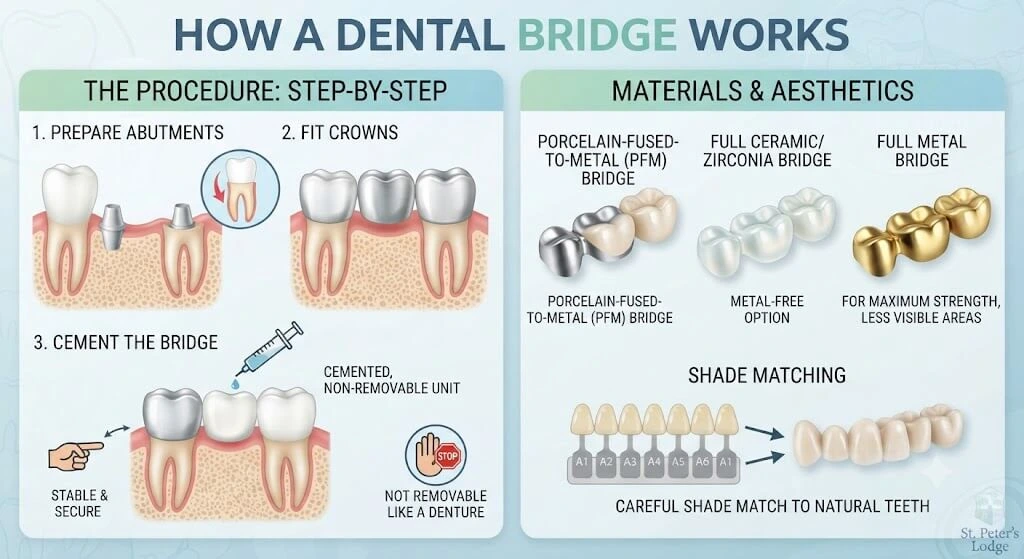
A bridge is a fixed prosthetic that spans the gap left by a missing tooth. The teeth either side the abutments are prepared and covered with crowns, and the replacement tooth, called a pontic, sits between them. The whole unit is cemented into place, so unlike a denture it is not removable at home.
We offer a choice of materials depending on where the bridge sits and how much it will be seen. The supporting structure is usually a precious or non-precious metal for strength, with porcelain or ceramic bonded to it in visible areas. Metal-free bridges are an option in some cases. The shade is matched carefully to your natural teeth.
Where a bridge tends to be the better choice
- You would rather avoid surgery, or a health condition makes surgery less suitable
- The teeth either side of the gap already have large fillings or need crowns anyway in which case little healthy tissue is being sacrificed
- There is not enough jawbone for an implant, and you would prefer not to have a bone graft
- You want the gap closed in weeks rather than months
What to weigh up
The trade-off is the healthy tooth structure removed from the abutment teeth, which cannot be put back. Bone beneath the pontic also receives no stimulation and can recede over the years. And because the whole unit is joined, a problem with one abutment tooth affects the entire bridge.
How a dental implant works
An implant replaces the root as well as the crown. A biocompatible titanium screw is placed surgically into the jawbone under local anaesthetic, where it acts as an artificial tooth root. Once healed, a small connector called an abutment is fitted, and a crown is secured on top.
The treatment runs in stages so the mouth can heal properly between them:
- Consultation we assess your oral health and jawbone density, take X-rays and talk through your options.
- Treatment planning a tailored plan setting out each stage and the expected timeline, with your appointments booked in.
- Implant surgery our implant surgeon places the titanium screw into the jawbone under local anaesthetic.
- Healing and osseointegration the implant fuses with the bone. This takes around six months and cannot be rushed.
- Fitting the restoration the abutment and crown are attached, completing the treatment.
Where an implant tends to be the better choice
- The teeth either side of the gap are healthy and you would rather not touch them
- You want the longest-lasting result and are comfortable with a longer treatment period
- Preserving jawbone matters to you, particularly if more teeth may need replacing later
- More than one tooth is missing and an implant-supported bridge would avoid crowning several healthy teeth
What to weigh up
Implants take months rather than weeks, involve minor surgery, and cost more up front. They also depend on having enough healthy jawbone where bone has already receded, a graft may be needed first, adding time and cost. Not everyone is a candidate, which is why the assessment at your consultation matters.
Which is right for you?
Most people arrive with a preference already, and the consultation is where that meets clinical reality. A few common situations:
The teeth either side of your gap are perfectly healthy. This is the strongest argument for an implant. Crowning two sound teeth to support a bridge means removing tissue that will never grow back worth avoiding if there is a way round it.
Those teeth already need crowns. The calculation flips. A bridge treats all three problems in one restoration, and the tooth preparation was going to happen anyway.
You need the gap closed quickly. A bridge is measured in weeks. An implant, because of the six months of healing, is measured in months. If a date is looming, that difference matters more than anything else on the list.
Bone has already been lost. If a tooth has been missing for a long time, the bone beneath may have receded. That does not rule out an implant, but it may mean a graft first. We will tell you honestly at the assessment.
Cost is the deciding factor. A bridge usually costs less at the outset. Over a long enough period the comparison narrows, because a bridge is more likely to need replacing. Both routes can be spread over time we currently offer 0% finance on dental treatments. See our fees and finance options.
There is no universal answer, and any dentist who gives you one without looking in your mouth is guessing. What we can promise is a written, fully-costed treatment plan covering both options before you commit to either.
Bridges vs Implants FAQs
Everything you need to know before choosing between a dental bridge and a dental implant.
Is a dental implant better than a bridge?
Neither is universally better. An implant lasts longer, preserves jawbone and leaves the neighbouring teeth untouched. A bridge is faster, avoids surgery and usually costs less at the outset. The right choice depends on the health of the teeth either side of the gap, how much jawbone you have, your timeline and your budget.
Which costs more, a bridge or an implant?
A bridge usually costs less at the outset, while an implant costs more up front but tends to last longer, so the gap narrows over time. Both are quoted individually, because the price depends on the number of teeth involved and the condition of your jawbone. We offer 0% finance to help spread the cost of either.
How long does each treatment take?
An implant usually takes three to nine months including healing, because the titanium screw needs around six months to fuse with the jawbone before the crown is fitted. A bridge is considerably faster, typically two to three weeks across two or three appointments, as no healing period is involved.
Does getting a bridge damage the healthy teeth either side?
The abutment teeth are prepared and crowned to anchor the bridge, so some healthy tooth structure is removed and cannot be replaced. Where those teeth already need crowns, little is lost. Where they are completely sound, an implant may be the more conservative option.
Is implant surgery painful?
The surgery is carried out under local anaesthetic, so you should not feel pain during the procedure. Some soreness and swelling for a few days afterwards is normal, and we will talk you through what to expect and how to manage it before you go ahead.
Can I have an implant if I have been missing the tooth for years?
Often yes, but the jawbone beneath a long-standing gap may have receded. If there is not enough bone to hold the implant securely, a bone graft may be needed first, which adds time and cost. We assess bone density with X-rays at your consultation and tell you honestly what is possible.
How do I clean a bridge compared with an implant?
An implant is brushed and flossed much like a natural tooth. A bridge needs cleaning underneath the false tooth every day using superfloss or a floss threader, because plaque trapped there can lead to bad breath and gum disease around the anchor teeth. Our hygienist will demonstrate the technique.
Do you offer both treatments in St Albans?
Yes. We provide both dental bridges and dental implants from our St Albans practice, welcoming patients from St Albans, Harpenden, Radlett and across Hertfordshire. Book a consultation online or call 01727 853160 and we will assess which option suits your mouth.
Not sure which one is right for you?
Book a consultation at St Peter’s Lodge and we will assess your teeth, your jawbone and your options, then give you a clear written plan covering both.
Kirit Siani
Dentist, St Peter’s Lodge Dental Practice, St Albans
Kirit qualified from the Guy’s, King’s and St Thomas’ Dental Institute in London in 2002, and holds a Diploma of Membership of the Faculty of General Dental Practitioners from the Royal College of Surgeons of England. He has a particular interest in cosmetic and restorative work, including crown and bridgework, and attends courses throughout the year to keep his practice current.


