

Dental crowns have traditionally involved two appointments and a temporary crown in between, a process that could take two to three weeks. CEREC technology has changed this. A CEREC crown is designed, milled, and fitted in a single appointment, typically within two hours, with no temporary crown and no impressions sent to an external laboratory.
At St Peter’s Lodge Dental Practice in St Albans, we use CEREC technology regularly for patients who need a crown and want the most efficient path to a finished, long-lasting result. Here is what the process involves and why patients consistently respond well to it.
Table of Contents
What Is CEREC?

CEREC stands for Chairside Economical Restoration of Esthetic Ceramics. The system combines digital scanning, computer-aided design software, and an in-practice milling unit to produce a porcelain crown from a single block of ceramic material while you wait.
The process begins with a digital scan of your tooth, which replaces the traditional impression material that many patients find uncomfortable. The software uses the scan to design a crown matched to your natural tooth colour and bite. The milling unit then carves the crown from a ceramic block. The dentist makes any final adjustments and cements the crown in place, usually within the same two-hour appointment.
When Is a Dental Crown Needed?
- After a root canal treatment, to protect and restore the treated tooth
- When a tooth is too heavily damaged or decayed to be restored with a filling alone
- To restore a broken or fractured tooth to full function
- To cover a tooth that has become severely discoloured and does not respond to whitening
- As the visible portion of a dental implant restoration
How CEREC Compares to Traditional Crowns
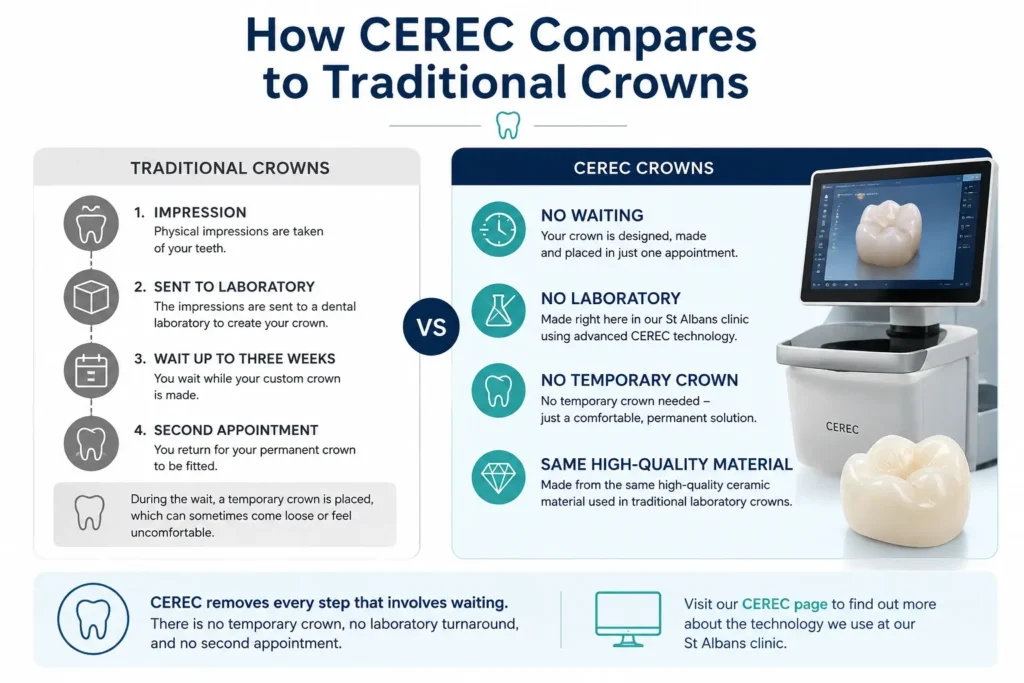
Traditional crown fabrication involves taking physical impressions, sending them to a dental laboratory, waiting up to three weeks, and attending a second appointment for the permanent crown to be fitted. During the wait, a temporary crown is placed, which can sometimes come loose or feel uncomfortable.
CEREC removes every step that involves waiting. There is no temporary crown, no laboratory turnaround, and no second appointment. The crown is made from the same high-quality ceramic material used in traditional laboratory crowns. Visit our CEREC page to find out more about the technology we use at our St Albans clinic.
What Do Patients Experience During a CEREC Appointment?
Most CEREC appointments follow a similar structure. The tooth is prepared in the same way as for any crown: anaesthetic is applied, any decay is removed, and the tooth is shaped to receive the crown. A digital scan replaces the impression tray. While the milling unit produces the crown, patients typically relax or take a short break. The dentist checks the fit, makes any micro-adjustments, and cements the crown in place.
The result is a permanent crown that is virtually indistinguishable from the surrounding natural teeth. You can learn more about restorative options including dental crowns on our general dentistry pages.
How Long Does a CEREC Crown Last?
CEREC crowns are made from high-strength ceramic and, with normal care, last fifteen or more years. They require the same maintenance as natural teeth: regular brushing, interdental cleaning, and routine dental check-ups. Patients who grind their teeth may be advised to wear a night guard to protect the crown from excessive wear.
Key Takeaways
CEREC same-day crowns are produced in a single appointment using digital scanning and in-practice milling technology. The process takes approximately two hours and eliminates the need for temporary crowns or laboratory waiting periods. The resulting ceramic crown is strong, natural-looking, and long-lasting, and comparable in quality to traditionally fabricated laboratory crowns. At St Peter’s Lodge Dental Practice in St Albans, CEREC crowns are available for patients who need a crown fitted and want the most efficient, comfortable experience possible.
Frequently Asked Questions
❓ Is a CEREC crown as strong as a traditional laboratory crown?
Yes. CEREC uses high-strength ceramic blocks designed specifically for use as dental crowns. The material is durable enough for both front and back teeth and performs comparably to traditionally fabricated porcelain crowns in terms of strength and longevity.
❓ Will a CEREC crown look natural?
CEREC software matches the crown to the shade and shape of your natural teeth. The ceramic material has a similar translucency to tooth enamel. Most patients report that people around them cannot tell which tooth has a crown.
❓ Is the CEREC process painful?
The tooth preparation stage is carried out under local anaesthetic, which means the procedure itself is comfortable. Some sensitivity in the days following is normal as the tooth adjusts. Most patients find the digital scanning process noticeably more comfortable than traditional impression material.
❓ How much does a CEREC crown cost in St Albans?
Crown costs vary depending on the tooth and the complexity of the case. Our fees page provides a starting point, and a consultation at St Peter’s Lodge will give you a specific cost based on your clinical situation.
Interested in a CEREC Crown at Our St Albans Clinic?
If you have been told you need a crown, or suspect you may, booking a personalized assessment at St Peter’s Lodge Dental Practice is your optimal next step.
Our experienced clinical team will confirm whether a crown is the right solution for your tooth structure, discuss our advanced single-visit CEREC option, and provide an accurate cost breakdown before any clinical work begins.


